Present Figures
Berlin 2021
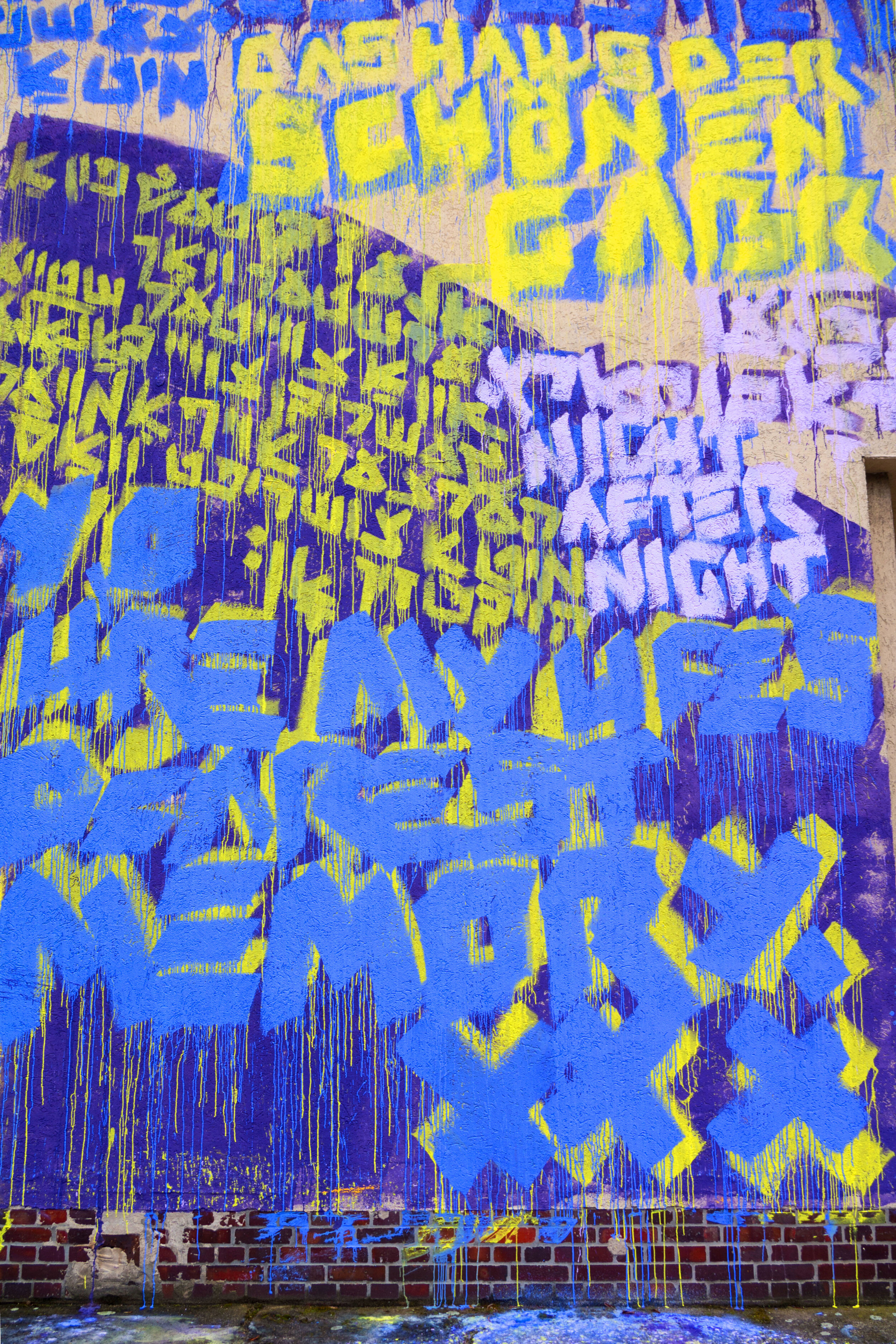
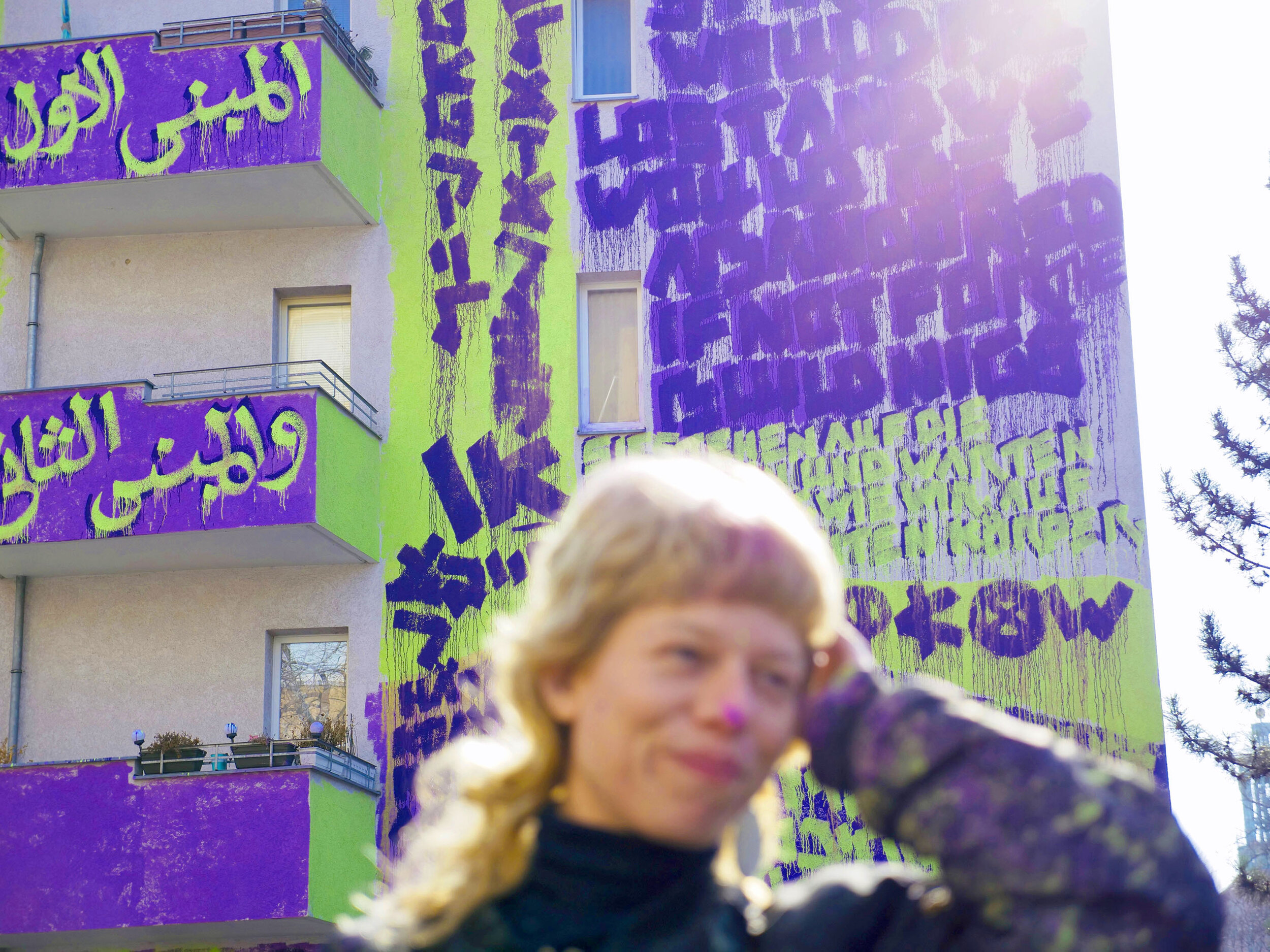
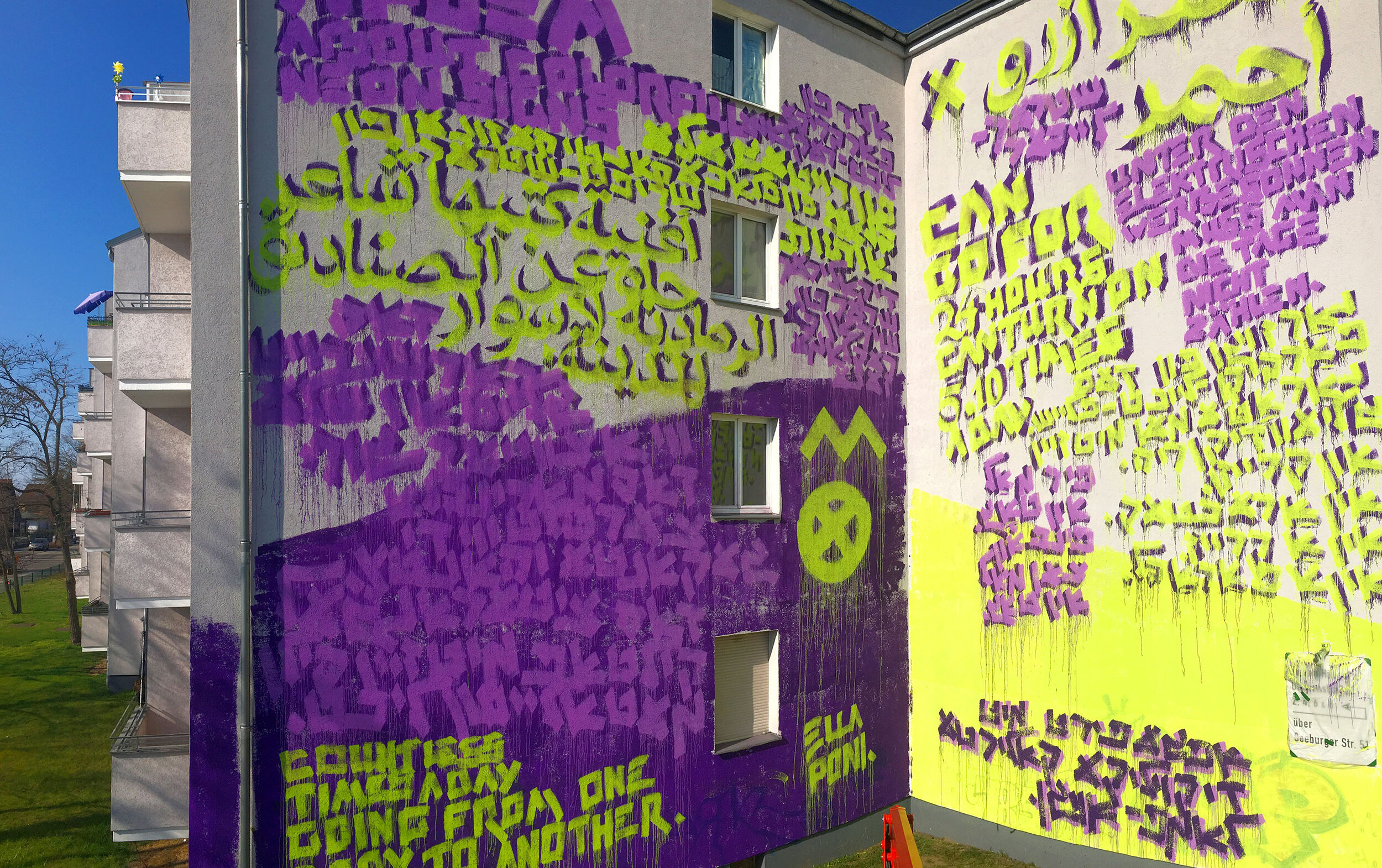
Three multilingual murals (Yiddish, Arabic, German, English) breathe new life into the urban poetic critique of overlooked philosopher and poet Debora Vogel. Inspired by her geometrically repetitive and minimalist poetics, the mural-montages draw parallels to current global challenges, urging viewers to embrace complexity and engage with abstract language.
The project emerges from the simultaneity of my artistic approach, Debora Vogel's ideas, and the discursive and aesthetic context within which it unfolds. Amidst the isolation ensnared in a repetitive loop of daily life, witnessing catastrophes unfold: the pandemic, the rise of fascism, global economic crises, and migration distress, a timeless resonance in Debora Vogel's poetry is discerned. “Present Figures” drew inspiration from her use of poetry as a means of critique.
Vogel's minimalist expression of everyday human struggles through geometric, repetitive poetry guided by emotions such as boredom and melancholy resonates with and deconstructs the urban condition of her era, demonstrating remarkable relevance to contemporary settings. The intervention aims to bestow a fresh voice to Vogel's words through a new interpretation, integrating them back into the urban space and bridging them to the present moment.
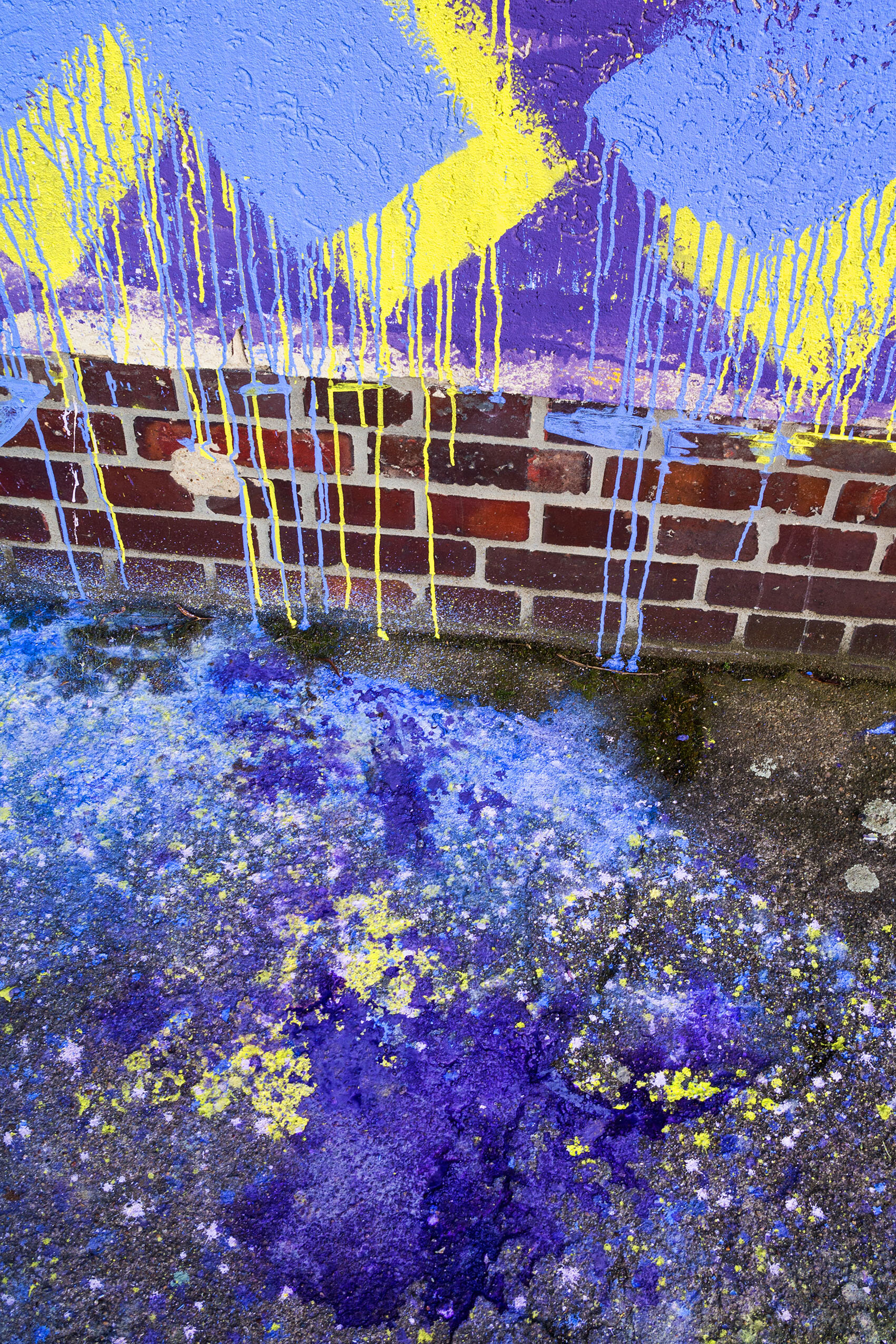
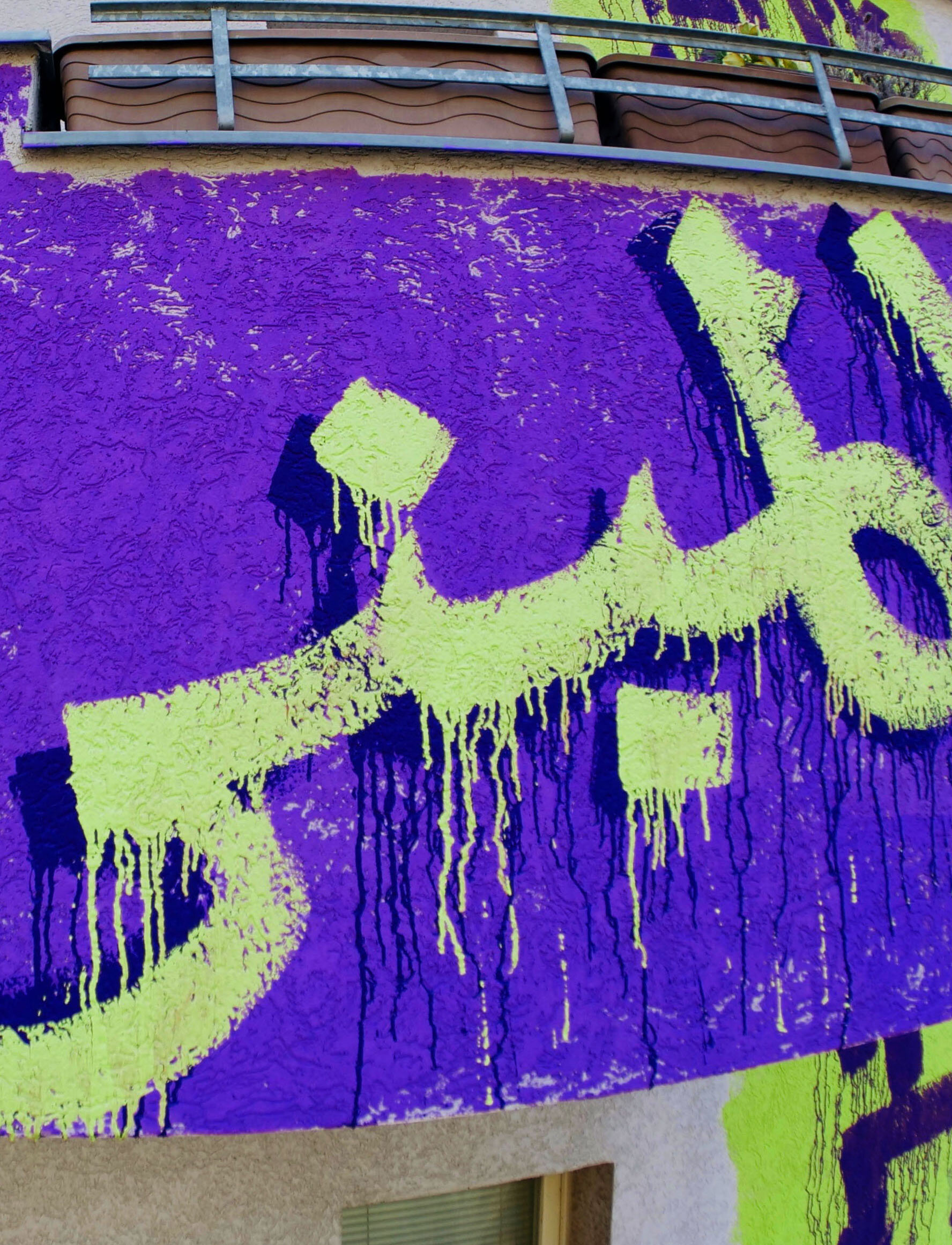
The "mural-montages," akin to Vogel's "montages," serve as a linguistic laboratory, treating poems and words as pictorial counterparts of geometric abstraction, shapes, and colours, reflecting the essence of objects and ideas. This visual poetry employs "hybrid calligraphy," interweaving variable typography systems in several languages (Yiddish, German, Arabic). Such fusion engenders a sub-text with obscured readability, resisting easy consumption by any reader/viewer and contradicting the rigidity commonly attributed to language. This abstraction approach materialises through the layered integration of narratives and inscriptions in a spontaneous act of real-time painting, responding directly to the text and location.
The urban visual poetry evades facile decipherment, inviting experiential engagement as a realm of emotion and intent, facilitating an interplay between past and present. The images generated possess multiple identities and inherent meanings. Text becomes a geometric surface that implies its hybrid identity, transcending language's inherent transience. Intersecting realities and temporalities give rise to a new textual form, reflecting upon the simultaneity of seemingly trivial and profound events of contemporary life in Berlin's public spaces.
Walls kindly provided by Szloma Albam Foundation
Locations & Dates:

*Debora Vogel
1902 Bursztyn – 1942 Lvov Ghetto


Advertising Panels in the Rain / Buildings and Streets / 1926 / The GAF No.28, Der Galaktische Futurist, 2020. Translation from Yiddish: Jordan Lee Schnee
Debora Vogel, a Polish philosopher and poet, a writer and aesthetic analyser, was also engaged in literary and art criticism, (dominantly about avant-garde works of art) wrote in Yiddish, Polish and German, often translating her own texts. Her highly experimental texts challenged every notion of writing in Yiddish in her own lifetime. She attempted to fuse modern art and poetry in a new style to create a new lyric poetry of the urban condition.
Vogel’s Poems, written in Yiddish even though it was not her mother tongue, but for her a “tongue mother” an adopted language 1, often capture cities in the age of rapid urbanization, mechanisation using the method of montage as a social critique of modern societies and as a sophisticated aesthetic at the same time. She juxtaposes images without overlaying them with interpretations. Instead she invites the viewer to piece them together and reach their own conclusions.
—
1. Blooming Spaces: The Collected Poetry, Prose, Critical Writing, and Letters of Debora Vogel, Edited by Anastasiya Lyubas, Academic Studies Press (October 20, 2020)
Buildings at Night
Day Figures / Buildings and Streets / 1926
Night streets would be lost
and we would be abandoned
if not for the buildings.
They stand on the streets.
And, like us, perhaps wait
for a second body.
So you can compare them to bodies,
a gray building with red light inside
and the second gray building. With yellow light.
The first building is like
a transparent light body,
which can still long for something
that could have come but didn’t.
And the second building is
a robust body with sweet light kernels
of longing of thirty evenings a month filled with waiting,
a building, which has given up waiting.
And you still have someone to go to
in the bodiless glass city sphere.

Translation from Yiddish: Anastasiya Lyubas / Blooming Spaces: The Collected Poetry, Prose, Critical Writing, and Letters of Debora Vogel, Academic Studies Press / 2020




A Poem about Colorful Neon Signs
Day Figures / Buildings and Streets / 1926
Seeburger Straße 51, 13581 Berlin-Spandau


The GAF No.28, Der Galaktische Futurist, 2020. Translation from Yiddish: Jordan Lee Schnee




Suburban Buildings
After Utrillo
Day Figures / Buildings and Streets / 1926
The GAF No.28, Der Galaktische Futurist, 2020. Translation from Yiddish: Jordan Lee Schnee


Photos by Robin Pailler and Arndt Beck
Project Team:
Production & Text:
Nikola Hartl
PR/Presse:
Anna Giannessi
an.giannessi@gmail.com
+49-152-554-116-03
Documentation:
Robin Pailler