
Language As Matter.
Artist Ella Ponizovsky Bergelson
Berlin 2026
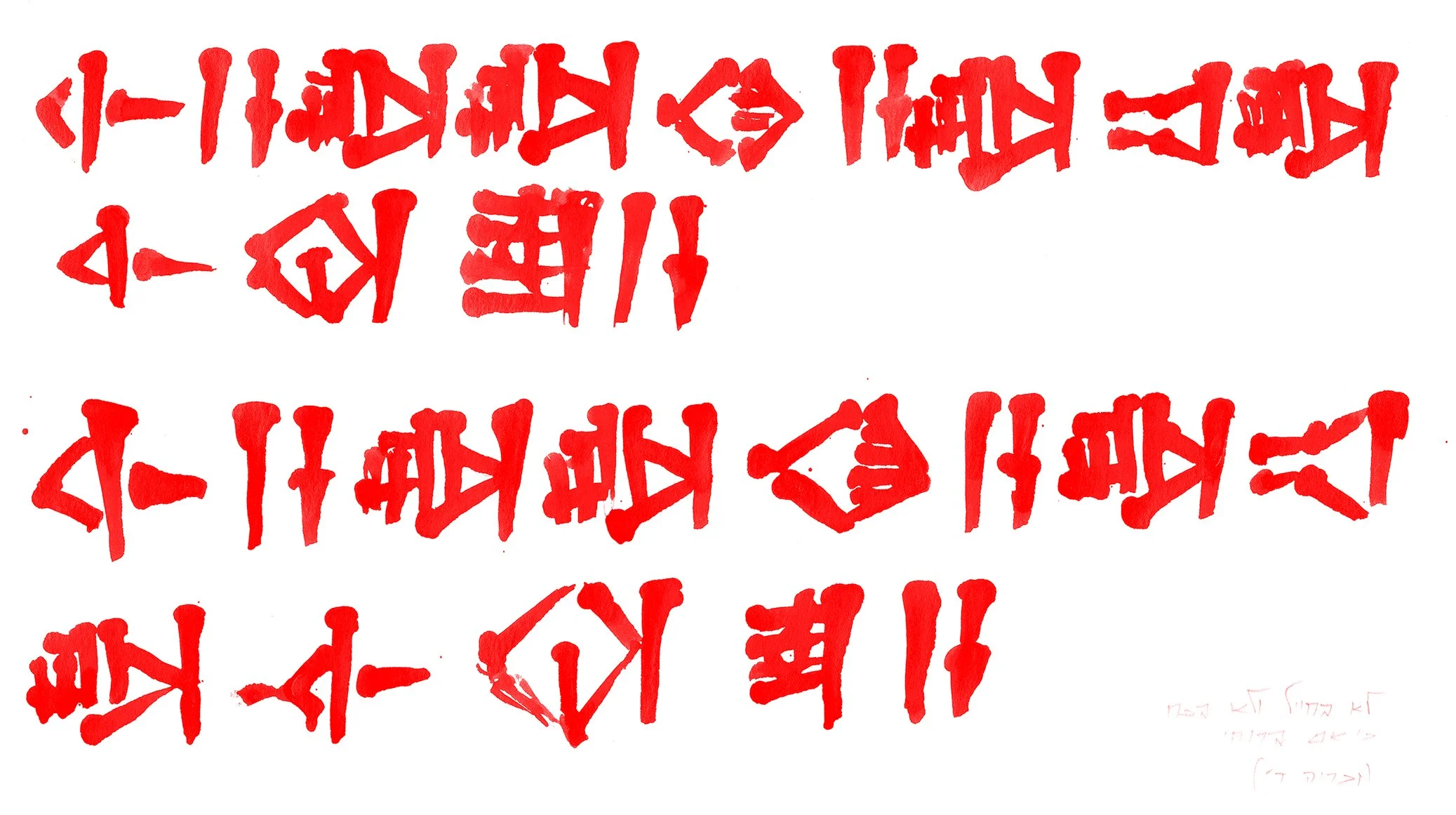
Ella Ponizovsky Bergelson works with language, by hand, at monumental scale. Her site-specific murals, calligraphic installations, and public interventions occupy walls, floors, architectural spaces. The scripts she works with reach from Proto-Canaanite alphabet and Babylonian cuneiform to the present: Yiddish, Arabic, Hebrew, Russian, German. A single work may contain five scripts, or seventeen. She uses language as material, a word as a body.
She was born in Moscow, immigrated to Israel in 1991, and has been based in Berlin since 2016. Her own nomadic experience of shifting between languages is where her preoccupation with scripts begins. Each writing system carries the nature of its culture in its visual form: its rules, its logic, its memory. When multiple scripts merge into one piece, the rigidity ascribed to each begins to dissolve. As legibility is obscured, the text tips over into its sub-context: its identity.
The sites she chooses are charged: a Holocaust memorial plaza in Philadelphia, the German pavilion at Venice, a Berlin S-Bahn freight shed, near which 30,000 Jewish Berliners were deported. Connecting a particular text to a particular place is, for her, a form of art: the text rewrites the place and the place rewrites the text. She draws from poets and authors such as Debora Vogel, Adi Keissar, Mahmoud Darwish, Max Czollek, among many others, living and dead. Her vandalistic interventions resist easy deciphering, hold more than one meaning at once, and sit at the point where the trivial and the world-changing collide.
She studied at Bezalel Academy of Art and Design in Jerusalem, then spent nearly a decade in Tel Aviv Jaffa at the intersection of typography, music, video and live performance, creating the visual language of musicians, bands, and events, work that would later drive her into public space. Among Refugees Generation Y (2017-2019) established the core terms of her Berlin practice: four temporary murals in lime paint, designed to fade, each layering Yiddish, German, and Arabic in sites saturated with historical weight, inspired by the story Among Refugees by Yiddish writer David Bergelson, the artist's great-grandfather. In 2025 she dedicated Lay-lah Lay-lah at the Horwitz-Wasserman Holocaust Memorial Plaza in Philadelphia, the first large-scale publicly commissioned Holocaust memorial mural in the United States, spanning 28 languages and 17 scripts.
Her interventions include the AR sculpture Pseudo-territory with Anna Elena Torres (2022), the Union Complex, Frankfurt (2024), Klingspor Museum, Offenbach am Main (2021), Antique Toy Museum, Mexico City (2020), ZK/U Berlin, Kindl Brauerei, and The Jerusalem Biennale (2019). Her work has been shown at POLIN Museum, Warsaw (2025), Künstlerhaus Bethanien, Berlin (2024), Literaturhaus Berlin (2019), the Museum of Islamic and Near Eastern Culture, and Jaffa Museum, Israel (2016–2017), among others. Residencies include ACC Galerie Weimar (2026), the Centre for the Study of Manuscript Cultures, Universität Hamburg (2025), LABA Berlin (2022), Mar'a'yeh program (2024), and Peleh, Berkeley (2017). Her writing is published in the Routledge Handbook of Translation and Migration UK (2024); her visual work in The Beauty of the Hebrew Letter (Brandeis University Press, 2023). Her work has been covered in Der Tagesspiegel, the Philadelphia Inquirer, Asymptote Journal, and Hyperallergic.