Lay-lah Lay-lah
Night Night
A mural at the
Horwitz-Wasserman
Holocaust Memorial Plaza,
Philadelphia 2025
In collaboration with the Philadelphia Holocaust Remembrance Foundation and Mural Arts Philadelphia.
Photo: Steve Weinik
A large-scale public mural,
created from texts gathered
across Philadelphia
in 28 languages.
A reflection on the connection between historic and contemporary displacement, collective memory, and the tension between cultural erasure and resilience in public art and Holocaust remembrance.
Mural Map
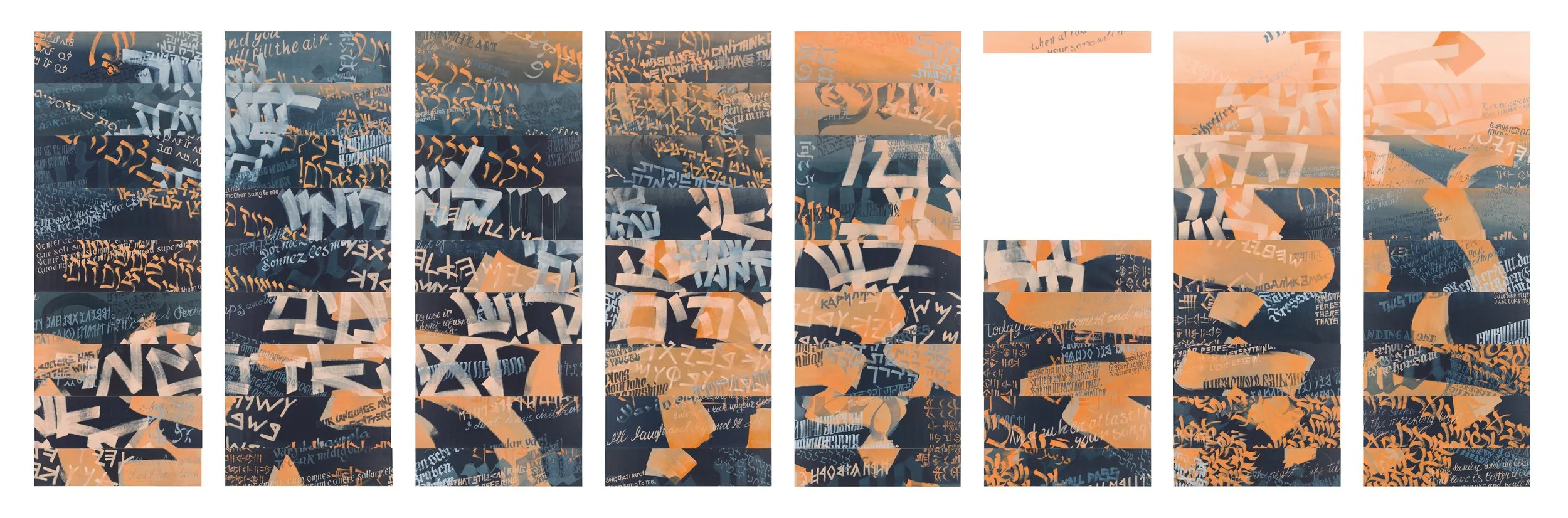
Overview
In 2021, the PHRF approached Mural Arts Philadelphia to initiate the creation of a Holocaust remembrance mural for the Horwitz-Wasserman Holocaust Memorial Plaza. The goal was to add a new visual storytelling element to the site. Following an international selection process, I was invited to realize the mural, based on my proposal from March 2024. The proposal drew on texts gathered from members of the Stakeholder Committee through the Memory Forms and proposed extending this process across Philadelphia to gather contributions for the final design.
A residency at the Center for the Study of Manuscript Cultures at Universität Hamburg guided the development of distinct calligraphic styles, and the final work was painted in Berlin before being shipped to Philadelphia, using a custom-developed method titled Layering and Displacement, which systematically fragments and reassembles the contributed texts. After a month-long installation, the mural was dedicated on September 26, 2025, as the first publicly commissioned, large-scale Holocaust remembrance mural in a civic space in the United States.
The mural was dedicated on September 26, 2025, as the first publicly commissioned, large-scale Holocaust remembrance mural in a civic space in the United States.


Photos by Gustavo Garcia and Steve Weinik
The Domino of Displacement
The Domino of Displacement
Historical continuity
and construction
of collective memory
Layering and Displacement in the Berlin Studio. June 2025
The forced uprooting that began in the 1930s and 40s did not stop with the liberation of camps or the end of the war. It propelled survivors into new geographies, reshaping cities, communities, and cultures far beyond Europe. That domino effect of displacement continues to shape the present, influencing how societies negotiate belonging, identity, and memory. The mural stands as a reminder that what began then is still unfolding.
The Holocaust is often narrated as an ending: the destruction of European Jewry, the downfall of Nazi Germany. Yet every ending is also a beginning. Lay-lah Lay-lah approaches this history as an evolving force, continually unfolding. Displacement set in motion during the Holocaust reverberates across time and continents, shaping identities, languages, and cultures long after the events themselves. Just as individual memory is fluid and subjective, so is collective memory ever-evolving, reshaped by the narratives and silences of its time and place.
Philadelphia
As a Setting
Site-specific Context
The mural stands at the Horwitz-Wasserman Holocaust Memorial Plaza, in dialogue with Nathan Rapoport’s Monument to Six Million Jewish Martyrs. Erected in 1964 by survivors and community leaders, it was the first public Holocaust memorial in the United States, a work of grief and defiance that framed the Plaza as a civic space of mourning and resistance. Lay-lah Lay-lah extends this legacy, connecting remembrance to the complexities of the present.
Philadelphia is both a local and symbolic American
stage.
During installation. Sep. 2025
The mural is also in dialogue with Philadelphia’s most prominent landmarks along the Benjamin Franklin Parkway: City Hall with William Penn rising above its tower at one end, and the Philadelphia Museum of Art at the other. Positioned between these anchors, the Plaza situates Holocaust remembrance within the city’s civic landscape, placing memory alongside symbols of governance, democracy, and art.
It is the birthplace of the Declaration of Independence, shaped by William Penn’s vision of tolerance, and home to the Liberty Bell, whose crack reminds that freedom is fragile. In this setting, Holocaust remembrance engages with both the promise of freedom, and the contradictions that have shaped it, and calls for the renewal of the unfinished work of tolerance, plurality, and coexistence.
Polyphony
of Voices
Every line in the mural comes from Philadelphia’s residents. Through a citywide call, participants were asked to share fragments of their childhood: lullabies, poems, and prayers.
Community engagement and participatory process
These contributions were gathered through Memory Forms, which invited people to record both genealogical details and textual traces passed down within families. The responses revealed how language and memory cross borders and generations, carrying the marks of displacement while also sustaining identity and belonging.
Memory Forms. Feb. 2024
Inscribed in 28 languages
and 17 scripts
Some ancient and extinct, these fragments affirm cultural survival. Placed together, they form a shared archive, a living record of how memory is transmitted and reshaped in dialogue with others.
The mural stages this process visually: overlapping, fractured, and partially hidden texts that invite viewers to recognize memory as collective, unstable, and always in formation. It asks what we choose to preserve, what we allow to fade, and how the stories of others enter into our own understanding of the past.
This work was shaped through community gatherings across Philadelphia, where residents offered their languages and memories into the project.
Public community meeting at WHYY . Dec. 2024
During a residency at
the Center for the Study of Manuscript Cultures at Universität Hamburg
I developed distinct calligraphic styles for each contribution, situating them within the long history of written transmission. Later, in Berlin, I painted the mural on parachute cloth panels, then it was shipped across the Atlantic and installed in Philadelphia.
Research and calligraphy development in the studio of the Center for the Study of Manuscript Cultures (CSMC), Universität Hamburg. February 2025
The creation process itself became
a metaphor for migration:
fragments assembled into a whole.
This work was made possible by: