Pseudo Territory
Video 2025
Ella Ponizovsky Bergelson & Anna Elena Torres
Shot in Venice, San Michele, Berlin, Poland, Greece, Edinburgh, and the Isle of Arran
Exhibited in:
The Power of Words.
On Jewish Languages.
POLIN Museum
of the History
of Polish Jews,
Warsaw.
21 November 2025 – 8 June 2026
Curated by: Tamara Sztyma
The video is both a documentation and an expansion of the work Pseudo Territory realized by the artists at the 59th Venice Biennale in 2022, part of the “Yiddishland Pavilion” (curators: Maria Veits and Yevgeniy Fiks).The artists created a virtual sculpture (AR sculpture) in which a pulsating thicket of letter-like shapes, created from a combination of the Paleo-Hebrew, Hebrew and Latin alphabets, was superimposed on a real image of the surroundings. The main message of both this work and the film presented here is the fluidity and transformations of languages, as well as the concept of language as an independent territory, building itself across geographical and political borders, in which culture develops. An important reference for the artists is the tradition of Jewish anarchist thought that developed in the early 20th century, which opposed borders and hierarchies and emphasized mutual aid and artistic freedom. They cite, in particular, the writings of the pre-war Jewish critic Baruch Rivkin, who coined the term 'pseudo-territory' to refer to Yiddish culture.
Video & Soundtrack Editing: Ella Ponizovsky Bergelson
Music: Chaia, “Daloy Politsey”
Voices: Jenny Romaine & Jeremiah Lockwood
Archivists & Researchers: Eléonore Biezunski, Tom Tearney, Sam Glauber-Zimra, YIVO Sound Archives
AR Development: Arhead
With thanks to Andy Drucker and Tanya Floaker
Photo: Maciej Jaźwiecki / POLIN
Burning Letters and Cherry Ink:
On Visualizing “Pseudo-Territory”
Anna Elena Torres
Daloy Politsey:
a Yiddish “Fuck the Police” for May Day
Chaia
We are living in a time of renewed nationalism and strict borders. Our work asks what happens when a territory is built from language rather than land. How identity can remain fluid. How a community can form through imagination, memory and shared cultural tools instead of through politics of exclusion.
Letters reflect histories of power, exclusion and belonging. When I combine Paleo Hebrew, Yiddish and English in one structure, it collapses the hierarchies that history created. The work becomes an anarchist proposition. Language as a shared commons. This links my practice to Anna’s research topics; early Jewish anarchist thought, which perceived language as a place of freedom and mutual aid. B. Rivkin’s idea, Pseudo Territory, that Yiddish culture formed a non-geographic territory is central. This culture lived in books, conversations and imagination rather than in borders. Our sculpture expands that idea into the present. It creates a meta space where letters build their own geography, develop through movement and dispersion, just like language does.
This project grows from my collaboration with Anna. Our dialogue combines visual practice, historical research, literary theory and political thought. The collaborative structure, the combination of diverse practices, mirrors the anarchist nature of the work. It is layered, generative and always evolving. The video includes footage from different locations. These are the paths of Anna and me. Some of the places we have been in the years since the sculpture was first created. The sculpture travels along.
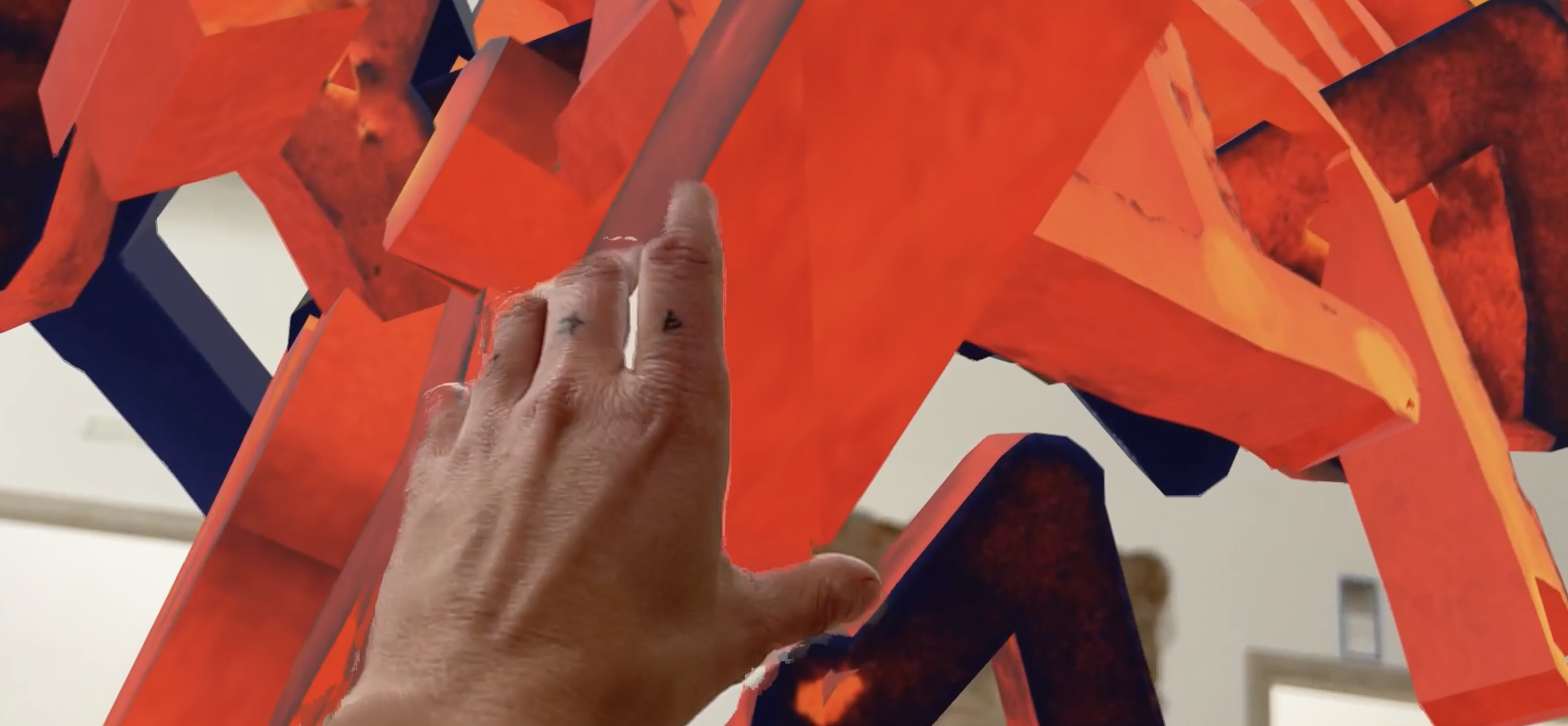
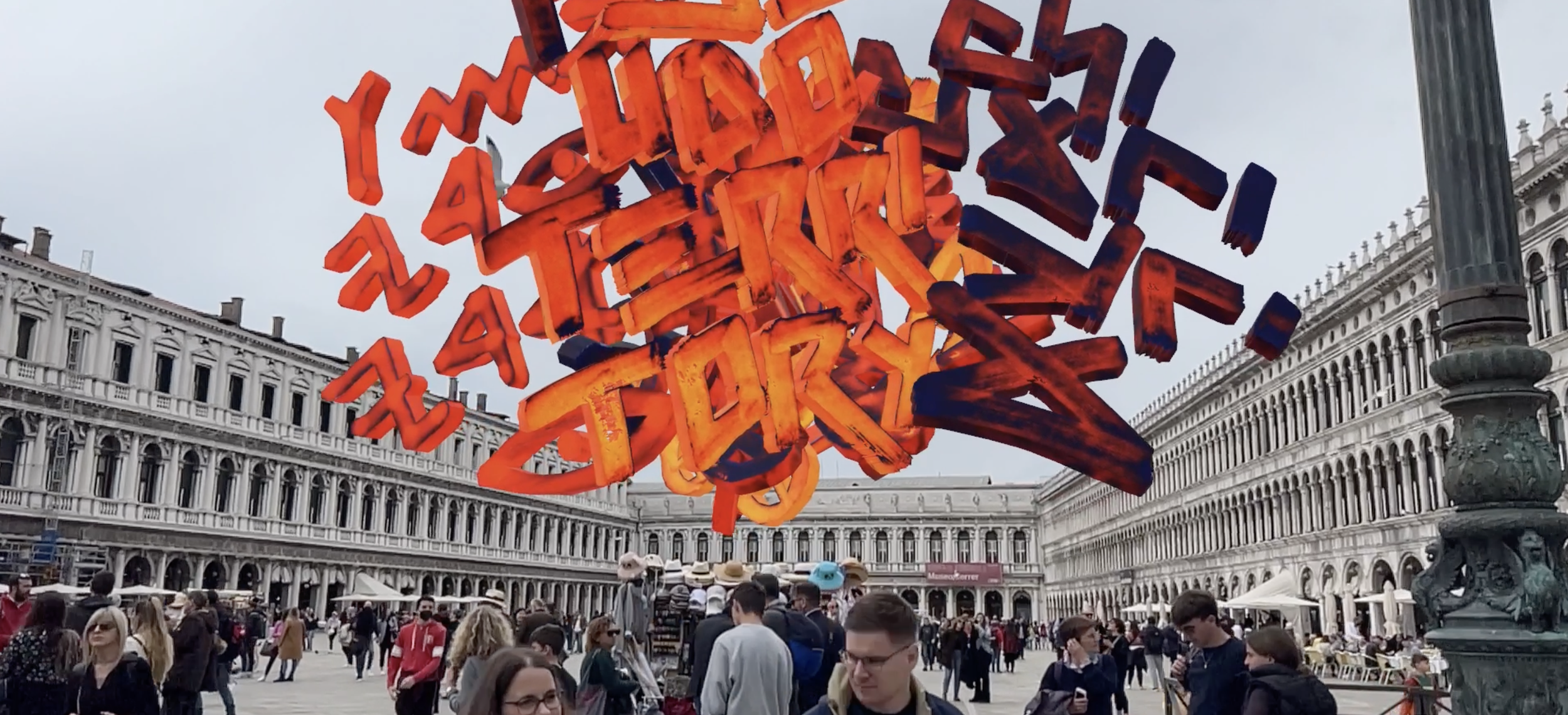
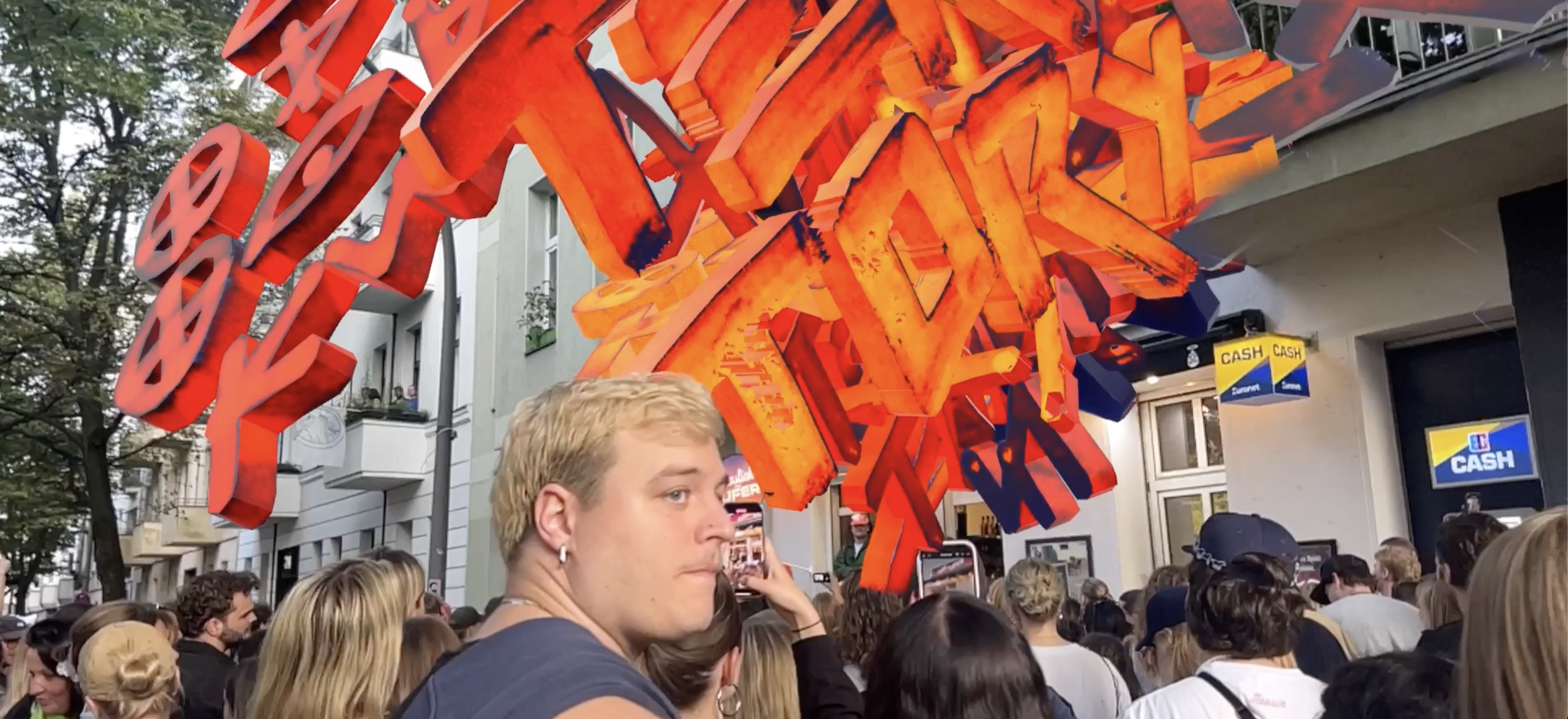
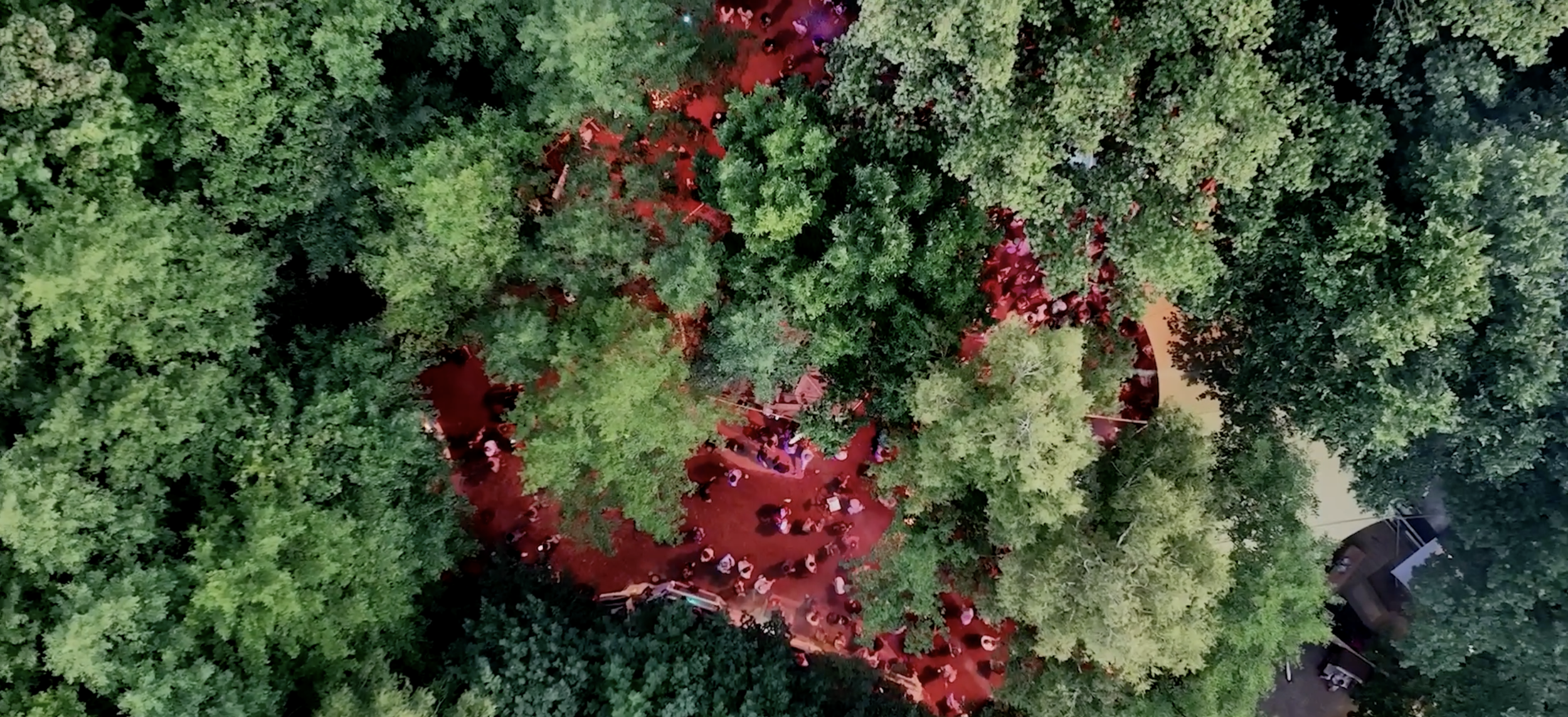
The exhibition shows a long history of Hebrew, Yiddish, Ladino and other Jewish languages that developed through migration and cultural exchange. Our work continues this logic. The sculpture is hybrid. It mutates. It refuses purity. It shows the same processes that shaped Jewish languages across centuries, but in a new medium. AR captures the instability and dynamism of cultural memory: it needs active participation in order to survive. It allows the work to appear depending on someone's position in space. It can only exist through the viewer’s movement and attention. The viewer is always involved. They animate the sculpture. With the video they travel through shifting landscapes and temporal disruptions. They participate in a space built from letters. This creates an experience that is shared and not imposed.
In our work text becomes spatial. It becomes a dimensional structure rather than a flat surface. In AR the letters behave like a living organism. They rotate, breathe, collide and create their own internal logic. They act upon the environment. The video work retains this spatial logic even after the AR becomes film. It gives language a physicality. A body.
When one tries to read, they’ll discover that these words resist full interpretation. When legibility breaks down, another form of encounter becomes possible. Visitors relate through texture, memory, rhythm, sound and movement. The editing techniques are an important layer. The flipping of the frame, the jump cuts between different geographies, the shifts in time, fast forward, slow motion and reversing the footage. These are simple editing tools that act as metaphors. They echo the anarchist logic of the piece. A refusal to obey physical boundaries of time and space. Just as the sculpture, the video crosses borders, disrupts linearity and established order.
Photo: Maciej Jaźwiecki / POLIN
The interactive installation in Polin museum hall. Photo: Maciej Jaźwiecki / POLIN
About the soundtrack:
Daloy Politsey:
A Note by Chaia
This soundtrack reimagines the 1905 Yiddish anti-police anthem “Daloy Politsey” as an act of anti-Zionist imagination. My setting shifts the song’s focus from revolutionaries resisting police to humans resisting the broader mechanisms of the state and, instead, embracing the divine. Set in the Yiddish anarchist imagination, the piece envisions a world where spiritual—not territorial—belonging defines Yiddish collective identity.
This piece uses musical language from Acid House, a genre envisioned by Black musicians in the 1980s as a form of social defiance in the face of redlining and police brutality. The club spaces where this genre thrived became refuges where Black expression could take shape beyond the confines of White racism.
From this foundation, Daloy Politsey becomes a radical invitation toward anti-Zionist possibility, urging us to imagine freedom and resistance in the uncharted spaces that defy oppressive structures of the State.
Tsukunft convention in Warsaw in June, 1932. Jewish youth carry banners with the names of their towns. source: Archives of the YIVO Institute for Jewish Research, New York
Ella Ponizovsky Bergelson - a Moscow-born, Israel-based and now Berlin-based artist who creates language-based interventions in public spaces and murals in public places, museums and galleries, forming a kind of “linguistic aesthetic” that she describes as “nomadic and anarchic.”
Anna Elena Torres - Torres's research examines Yiddish literature in relation to ecology, migration, labor, and kinship/comradeship. Dr. Torres is the author of Horizons Blossom, Borders Vanish: Anarchism and Yiddish Literature (Yale University Press, 2024), A Bear Flew By: Animality in Yiddish Arts and Literature (Rutgers University Press, forthcoming), and the co-editor of With Freedom in Our Ears: Histories of Jewish Anarchism (University of Illinois Press, 2023).
Supported by: